AI workflow automation: a practical starting guide for growing businesses
Skip the hype. These are the places AI reliably saves hours in a growing business today, and the guardrails that keep it safe.
AI can now read documents, summarise records and answer questions in plain language. For a growing business, the opportunity isn’t a futuristic robot. It is removing the hours your team spends retyping, checking and searching.
The trick is to start where AI is reliable and the payoff is easy to measure. Here is a practical way to do that.
Three places AI pays off today
1. Reading documents so nobody retypes them
Supplier bills, printed menus, purchase orders, forms and ID documents all carry data someone types into a system by hand. AI can read a photo or PDF and fill in the fields in seconds. In our restaurant POS, Covers, a photo of a printed menu becomes dishes, sizes and prices in about 25 seconds, ready for a person to check.
2. Answering questions from your own data
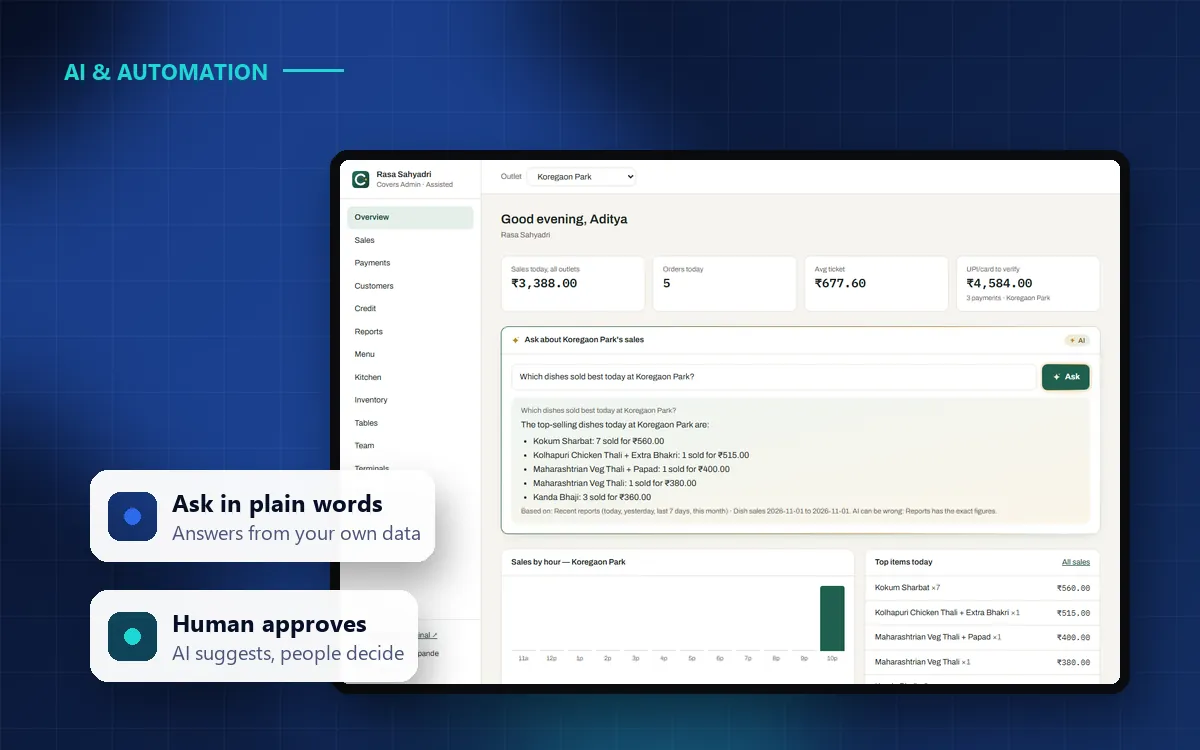
Owners and managers rarely have time to open reports and build filters. Letting them ask “how did Baner do yesterday?” or “which products sold best this week?” in plain words, and answering from the business’s own records, turns reports into decisions.
3. Spotting what deserves a look
Unusual discounts, cancelled items, cash differences or a spike in returns are easy to miss in long lists. AI can scan the records every day and write a short summary of what stands out, with links to the entries behind each point.
Guardrails that keep AI safe
- People approve, AI suggests. Anything that changes records, money or customer communication should be reviewed by a person first.
- Answers come from your data. Ground answers in your own records and show where the numbers came from, so nobody acts on a guess.
- Keep a trail. Record what the AI suggested and who approved it.
- Protect sensitive data. Send only what is needed, and choose providers with clear data-handling terms.
The best AI features don’t feel like AI. They feel like a colleague who did the boring part before you arrived.
How to start in four weeks
- Week 1: list the repetitive work. Ask each team what they type, copy or check every day. Note how long it takes.
- Week 2: pick one task. Choose something frequent, rule-based and easy to verify, such as entering supplier bills.
- Week 3: pilot with review. Let AI prepare the work and a person approve it. Track time saved and corrections needed.
- Week 4: decide. If accuracy and time saved are good, roll it out and pick the next task.
Key takeaways
Start with document reading, plain-language questions and daily summaries. Keep a person in the loop and measure the hours saved. We design and build these workflows for businesses across India: see our AI and workflow automation services.