Offline-first software: why your business can’t depend on perfect internet
Internet drops are a normal part of business in India. Here is what offline-first software means, why it matters, and how to tell if a product really has it.
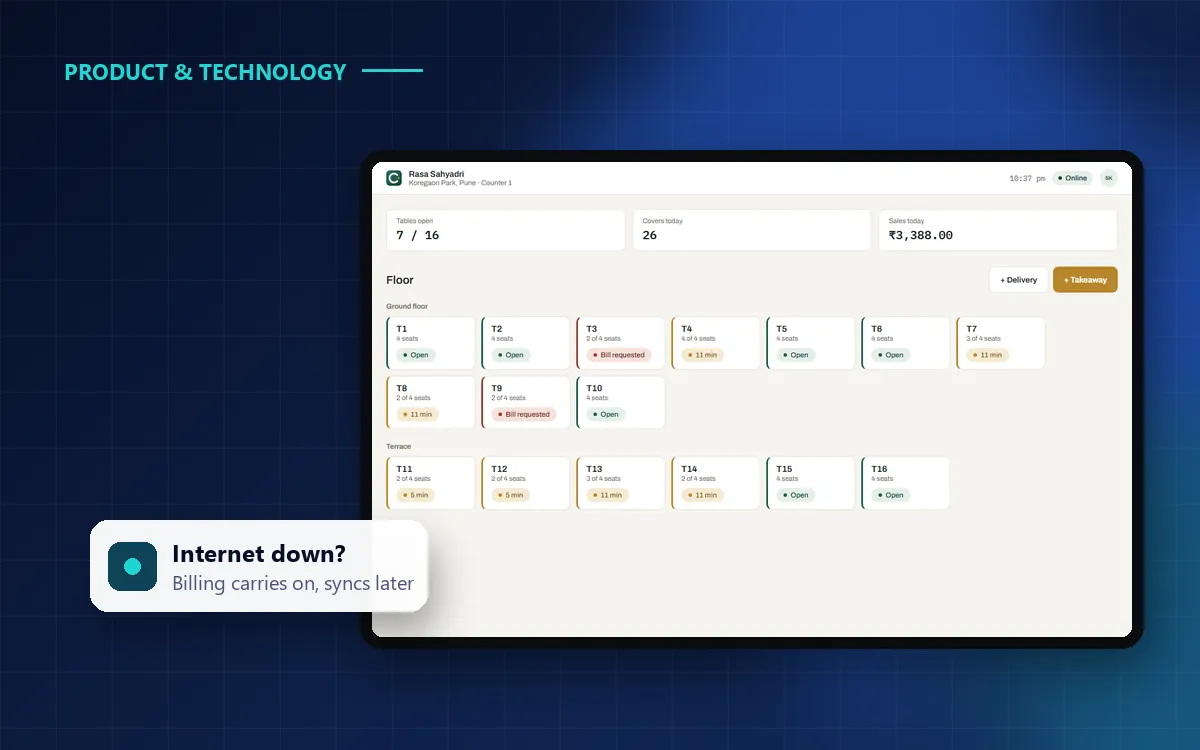
Most business software is built and tested in offices with fast, reliable internet. Most Indian businesses don’t run in those offices. They run in busy restaurants, crowded shops, warehouses and on the road, where the connection drops at the worst possible moment.
When the internet goes, cloud-only software stops. Bills can’t be printed, orders can’t reach the kitchen, and the queue at the counter grows. Offline-first software is designed the other way round: it assumes the connection will fail, and keeps working when it does.
What “offline-first” actually means
Offline-first software does its work on the device in front of you, then shares it with the cloud and other devices when it can. The internet becomes a way to back up and share data, not something every tap depends on.
- Work continues locally. Orders, bills, payments and records are saved on the device the moment they happen.
- Devices talk to each other nearby. A counter tablet and a kitchen screen in the same building keep in step over the local network, even with no internet.
- Everything syncs later. When the connection returns, the records reach the cloud and every other device, in the right order and without duplicates.
Why it matters more in India
Connectivity in India has improved enormously, but it is still uneven. Broadband goes down in the rain, mobile data slows in crowded areas, and power cuts take routers offline. For a business, even ten minutes without billing means lost sales, unhappy customers and staff writing things on paper that never get entered later.
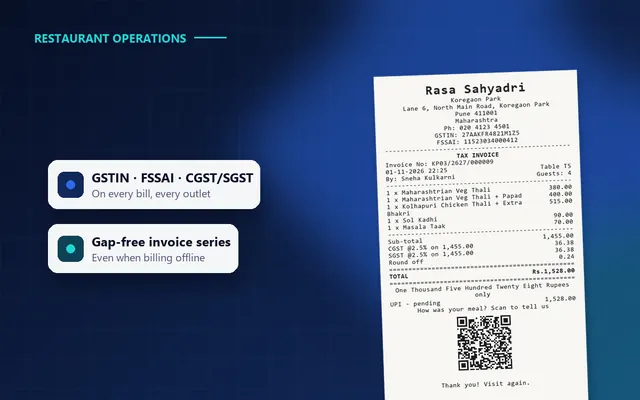
There is also a compliance angle. Tax invoices need correct, gap-free numbering. If staff switch to handwritten bills during an outage, the numbering and GST records break. Software that keeps issuing proper invoices offline avoids that problem completely.
Questions to ask any vendor
Many products say they “work offline” when they only show a cached screen. Before you buy, ask these questions and ask to see it happen:
- If I unplug the router during a busy hour, can I still create a bill, print it and take payment?
- Do orders still reach the kitchen or warehouse screen with no internet?
- How are invoice numbers kept unique and in sequence when several devices bill offline at the same time?
- What happens to data if a device is lost before it syncs?
- How will I know when something hasn’t synced yet?
A good test: switch off the Wi-Fi in the middle of a demo. If the vendor hesitates, you have your answer.
How we build it
At Asquarics, offline-first is a starting assumption, not an add-on. Our restaurant POS, Covers, keeps billing, kitchen tickets and payments running when the internet drops. Terminals in an outlet share orders over the local network, every terminal has its own gap-free invoice series, and everything syncs to the cloud when the connection is back. Every action is recorded by name and verified, so nothing gets lost or changed along the way.
The same thinking goes into the custom software we build for field teams, warehouses and multi-site businesses.
Key takeaways
Assume the internet will fail and pick software that keeps working when it does. Test it yourself before you commit. If you need software that holds up in real Indian conditions, talk to us.